Food journaling without seeing calories: tracking for people with food noise
Keep the benefits of a food journal — awareness, patterns, coach support — without a calorie number at every meal.
arrow_back All articles
There's a group of people every calorie app quietly fails: the ones for whom the numbers themselves are the problem. Maybe tracking once tipped into obsession. Maybe a coach advised against calorie counting. Maybe a red "1,850 / 1,800" banner at dinner turns food into arithmetic and arithmetic into anxiety — the constant mental chatter about food called food noise.
Researchers define food noise as persistent, intrusive thoughts about food that create cognitive burden and emotional distress — distinct from normal hunger cues (Allison et al., 2025). A 2023 conceptual model frames it as an advanced stage of food cue reactivity that can drive disordered eating patterns (Ribeiro et al., 2023).
The standard advice is "then don't track". But that throws away the single most evidence-backed self-monitoring tool in behavior change. There's a middle path: journal the food, hide the numbers.
What the science actually says
The consistent finding across dietary self-monitoring research is that the act of recording drives most of the benefit:
- Awareness. Recording a meal forces a moment of attention.
- Patterns. A week of entries reveals the 4 pm vending-machine run and the weekend portion drift.
- Consistency beats precision. Frequency of logging predicts outcomes better than the accuracy of any single entry.
A 2021 meta-analysis of 12 RCTs found that digital self-monitoring of diet led to a mean weight loss of −2.87 kg vs. control (95% CI −3.78 to −1.96, p < 0.001), with tailored interventions significantly more effective than generic ones (Berry et al., 2021). Another systematic review of 59 interventions confirmed that both high- and low-intensity self-monitoring strategies produced significant weight loss — the key factor was doing it consistently, not logging every micro-detail (Hagemann et al., 2021).
Notice what's absent from the evidence: staring at a calorie total. The number is one view of the record — it isn't the record.
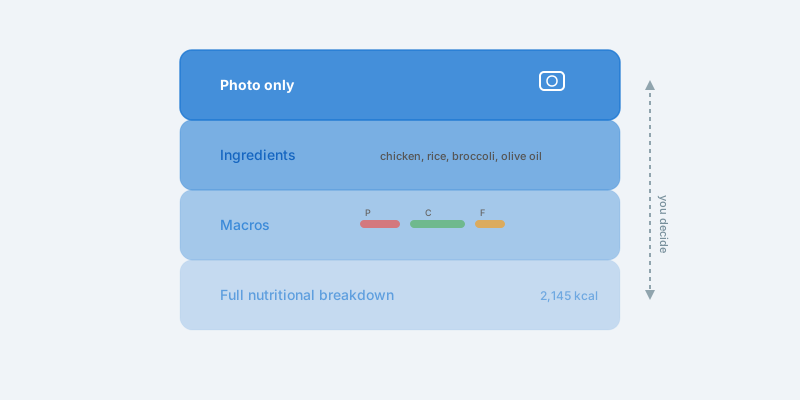
The photo journal: maximum signal, minimum noise
A photo is the gentlest possible food log. In NutritionCam, detail visibility is a setting, not a tier. You choose which layers you see:
- Photos only — a visual diary. What you ate, when.
- + Ingredients — the AI's breakdown, no numbers.
- + Macros — protein/carbs/fat balance, still no calorie total.
- + Calories & micronutrients — the full picture, when and if you want it. (Micronutrient insights are available on the Premium plan.)
The AI analyzes every photo either way — the data exists, safely out of view. Change your mind in a month, and your whole history fills in retroactively.
A 2020 meta-analysis showed that mHealth self-monitoring apps yield higher long-term adherence than paper journals, particularly when combined with coaching support (Hernández-Reyes et al., 2020).
The coach pattern
- You photograph meals — that's your entire job.
- Your coach reviews the full analysis — dishes, portions, macros, trends.
- Conversations happen about food and habits, not numbers.
Practitioners working with disordered-eating histories often want exactly this split: client sees the journal, professional sees the data. A 2023 meta-analysis confirmed that combined app + coaching interventions produced significant weight loss of −2.15 kg and waist circumference reduction of −2.48 cm (Macedo et al., 2023).
Is hiding calories just avoidance?
For some goals you eventually want numbers. But the habit loop must survive first: a journaling practice you maintain for a year at low detail beats a quantified sprint you abandon in week three. And for many people the awareness is the intervention.
Set it up in two minutes
- Create a free NutritionCam account (no credit card).
- In settings, switch off calories — and macros too, if you like.
- Photograph your next meal. That's the whole workflow.
A food journal that respects your head. See as much — or as little — as you want.
References
- Allison, D. B. et al. (2025). Food noise: definition, measurement, and future research directions. Nutrition & Diabetes. doi:10.1038/s41387-025-00382-x
- Berry, R. et al. (2021). Does self-monitoring diet and physical activity using digital technology support adults with obesity to lose weight? Obesity Reviews, 22(10). doi:10.1111/obr.13306
- Hagemann, D. et al. (2021). A systematic review of dietary self-monitoring in behavioural weight loss interventions. Public Health Nutrition, 25(5). doi:10.1017/S136898002100358X
- Hernández-Reyes, A. et al. (2020). Effect of mHealth self-monitoring on weight loss: A systematic review and meta-analysis. Nutrients, 12(7), 1977. doi:10.3390/nu12071977
- Macedo, D. M. et al. (2023). Combined health coaching and self-monitoring apps for weight-related outcomes. J Med Internet Res, 25, e42432. doi:10.2196/42432
- Ribeiro, G. et al. (2023). What is food noise? A conceptual model of food cue reactivity. Nutrients, 15(22), 4809. doi:10.3390/nu15224809