Carbs on food labels: US vs Europe — why the numbers don't match
Total carbs, net carbs, fiber inside or outside — food labels report carbohydrates differently across the world. Here's what that means for your diet and why NutritionCam follows the European convention.
arrow_back All articles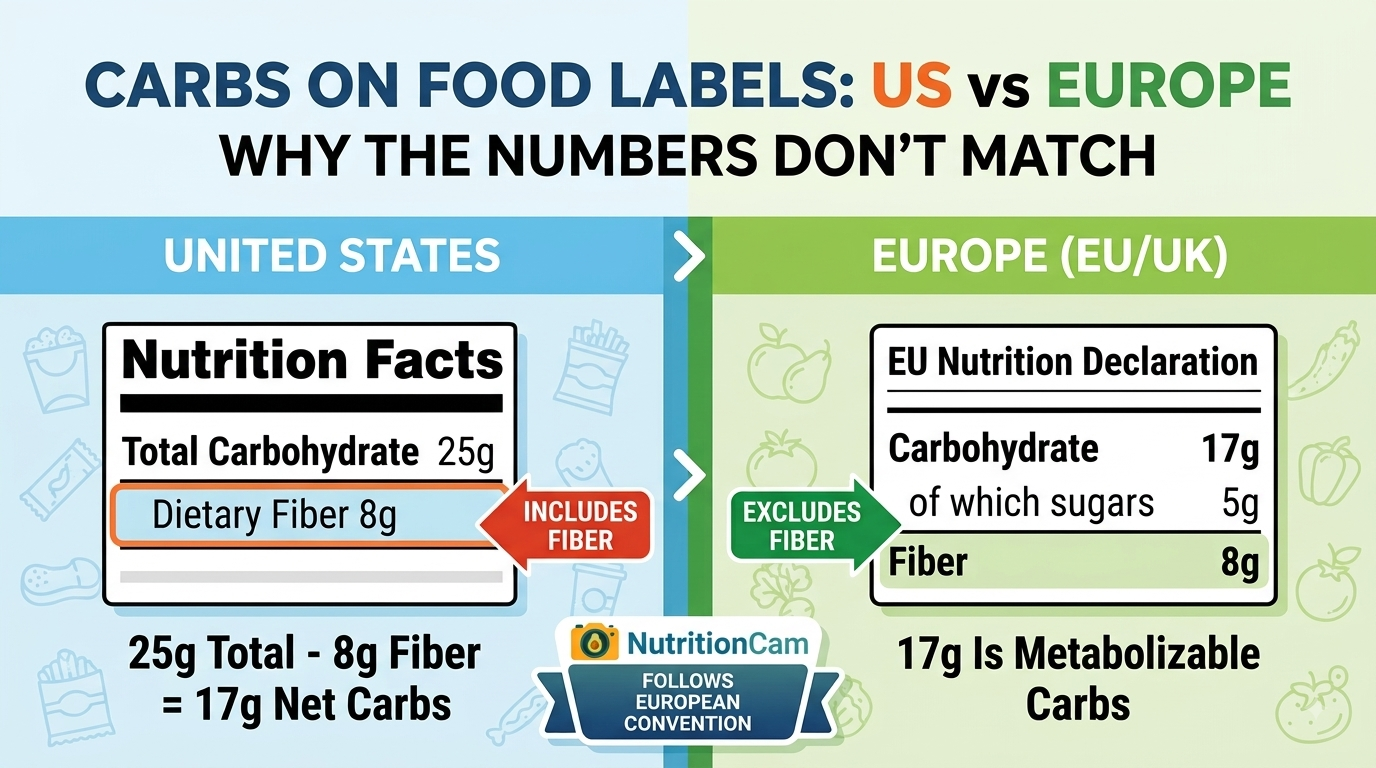
If you've ever compared nutrition labels from different countries, you may have noticed something odd: the same product can show different carbohydrate values depending on where it was sold. That's not a mistake — it's a fundamental difference in how regions define and report carbohydrates.
How the US reports carbs
In the United States, the FDA's "Nutrition Facts" label reports Total Carbohydrate. This number includes:
- Sugars (simple carbs)
- Dietary fiber
- Starch and other complex carbs
- Sugar alcohols (when present)
Fiber is then listed as a sub-item under Total Carbohydrate. If you're counting "net carbs" for a keto or low-carb diet, you have to do the subtraction yourself:
Net carbs = Total Carbohydrate − Fiber − Sugar Alcohols
For example, a US label showing 25g total carbs with 8g fiber means 17g net carbs — but the headline number is 25g.
How Europe reports carbs
The European Union's regulation (EU No 1169/2011) requires labels to show Carbohydrate, defined as:
Any carbohydrate which is metabolised by humans, including polyols.
Crucially, fiber is not included in this number. Fiber gets its own separate line on EU labels. So the European "Carbohydrate" value is essentially what Americans call "net carbs."
The same product that reads 25g carbs on a US label might read 17g carbs on a European label — because the 8g of fiber was already excluded.
Other regions
| Region | Carb definition | Fiber included? |
|---|---|---|
| United States / Canada | Total Carbohydrate | Yes (listed as sub-item) |
| European Union | Carbohydrate (metabolisable) | No (separate line) |
| United Kingdom | Carbohydrate (same as EU) | No (separate line) |
| Australia / New Zealand | Total Carbohydrate | Yes (listed as sub-item) |
| Japan | Carbohydrate (炭水化物) | Varies — some labels include, some exclude |
| India | Total Carbohydrate | Yes |
| Brazil | Carboidratos totais | Yes (fiber separate) |
Why this matters for your diet
Keto and low-carb diets
If you follow a keto diet aiming for under 20g net carbs, reading labels wrong can throw you off significantly. A product with 30g US "total carbs" might have only 18g European-style carbs — perfectly keto-friendly. Conversely, trusting a US label at face value might cause you to avoid foods that fit your macros.
Calorie counting
The calorie impact is the same regardless of how carbs are labeled — your body processes fiber differently (it contributes roughly 2 kcal/g vs 4 kcal/g for digestible carbs), and most label calorie calculations already account for this. But if you track carbs as a macro target, the labeling system you use matters.
Diabetic carb counting
For people managing blood sugar, the European system is arguably more useful because it directly shows the carbohydrates that will affect glycemic response. Fiber doesn't raise blood sugar, so the EU number maps more closely to the insulin-relevant carb load.
Why NutritionCam uses the European convention
When our AI analyzes a meal, it reports carbohydrates the European way: metabolisable carbs, with fiber reported separately. Here's why:
It's the actionable number. Whether you're managing blood sugar, counting net carbs for keto, or tracking macros — the carbs that affect your body are the ones without fiber. Showing this directly saves a calculation step.
Fiber deserves its own spotlight. Fiber is a nutrient most people should eat more of. Burying it inside the carb total hides a number that deserves attention on its own.
International consistency. Our users span the globe. The European definition avoids the confusion of "total vs net" and gives everyone the same baseline number to work with.
Scientific alignment. Nutrition research increasingly distinguishes between digestible and non-digestible carbohydrates. The EU approach reflects this distinction at the label level.
What to watch out for
- When scanning US products: if you compare a US label's total carbs against your NutritionCam log, your log will look lower. That's expected — it's not undercounting, it's excluding fiber.
- When entering foods manually: enter the European-style carb value (or the "net carbs" from US labels), and log fiber separately.
- Sugar alcohols: these are partially absorbed. NutritionCam includes sugar alcohols in the carbohydrate value (as the EU regulation requires), since their metabolic impact varies by type and person.
The bottom line
There is no single "correct" way to report carbohydrates — it depends on what you want the number to tell you. The US system gives you everything lumped together; the European system gives you the metabolically active portion. NutritionCam chose the European logic because it gives you the number that matters most for daily decision-making — and shows fiber as the important nutrient it is, right alongside.