AI vs. your eyes: why a camera counts calories more honestly than you do
Research shows humans underreport calories by 25–50%, especially when dieting. AI photo analysis removes the bias. Here is what the science says.
arrow_back All articlesYou know what you eat. You tracked it all day. Yet somehow the scale disagrees. The problem is rarely metabolism — it is perception. Decades of research show that human calorie estimation is systematically biased, and the bias gets worse the more motivated you are to hit a target.
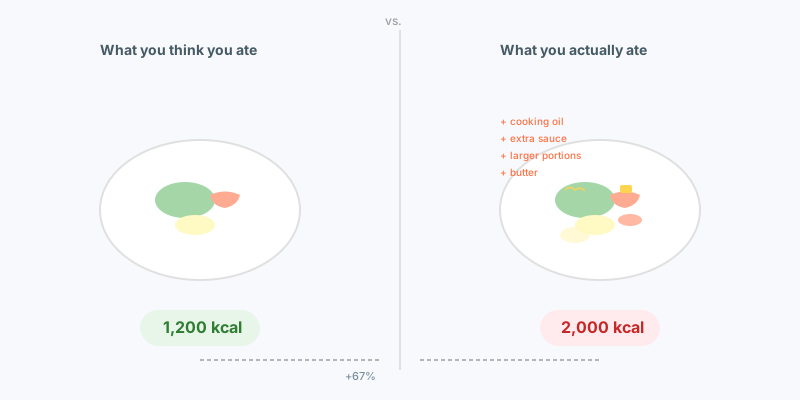
The underreporting problem
A landmark 1992 study in the New England Journal of Medicine measured actual intake of "diet-resistant" obese subjects against their self-reports. The result: participants reported eating 1,028 kcal/day while their actual intake was 2,081 kcal/day — an underreporting gap of 47% (Lichtman et al., NEJM 1992).
This is not a moral failing. It is a well-documented cognitive pattern.
It gets worse when you have a goal
A 2025 epidemiological analysis of 18,150 NHANES participants found that people on low-calorie diets underreport almost twice as often as the general population (38.8% vs 22.9%; OR 2.32). Those on carb-restrictive diets showed an even higher rate: 43.8% (Storz & Ronco, Current Developments in Nutrition 2025).
Meanwhile, weight-loss maintainers — people who already hit their goal — underreport by a median of 605 kcal/day (−25.3%), significantly more than normal-weight controls (−308 kcal/day, −14.3%) (Pfrimer et al., Am J Clin Nutr 2021).
The pattern is consistent: the more invested you are in a calorie number, the more your brain bends reality to match.
Why does this happen?
Three cognitive forces work against you:
- Portion size blindness. Humans chronically underestimate portions of energy-dense foods and overestimate portions of vegetables. The error compounds with every ingredient on the plate.
- Confirmation bias. When you believe you are eating 1,500 kcal, you unconsciously remember the small salad and forget the handful of nuts.
- Social desirability. Even in private food diaries, people omit "shameful" foods — research shows fats and snacks are disproportionately underreported.
A systematic review (Ravelli & Schoeller, Frontiers in Nutrition 2020) confirmed that underreporting increases with BMI and is not evenly distributed across food types — making manual tracking unreliable precisely for the people who need it most.
What does AI do differently?
An AI food model looks at your plate with no goals, no feelings about carbs, and no memory of yesterday's cheat meal. A 2024 systematic review (Shonkoff et al., Annals of Medicine 2023) comparing AI image-based dietary assessment to human assessors concluded that AI accuracy "aligns with — and has the potential to exceed — accuracy of human estimations."
Specific findings:
- 36% MAPE (mean absolute percentage error) for the best models on mixed meals — comparable to traditional self-reported methods, but without the user burden or motivational distortion (Fridolfsson et al., 2025).
- AI models correctly identify food items up to 87.5% of the time without fine-tuning.
- Median energy estimate differed just 0.1% from actual across 114 photos, though individual meal estimates varied more (O'Hara et al., 2025).
The critical difference: AI error is random noise. Human error is systematic — and it systematically points in the direction you want to believe.
Random error vs. directional bias
Imagine two scales. One fluctuates randomly ±5 kg around your true weight. The other consistently reads 3 kg lighter. Which one leads to worse decisions?
AI calorie estimates scatter around the true value. They can overestimate or underestimate a single meal. Over a week, those errors tend to cancel out.
Human estimation consistently bends in one direction: downward when dieting, upward when bulking. Over a week, the error accumulates — and you cannot correct what you cannot see.
A camera does not negotiate with your willpower
When NutritionCam analyzes your plate, it does not know you are trying to stay under 1,800 kcal. It does not feel guilty about the extra tablespoon of olive oil. It does not "round down" the rice portion because you went for a run this morning.
It measures what it sees — then you decide what to do with that number.
Does this mean AI is perfect?
No. Current AI models still struggle with:
- Hidden fats (oil drizzled after plating, butter melted inside)
- Very large portions (systematic underestimation grows with plate size)
- Complex layered dishes
But these limitations are known, predictable, and improving with each model generation. Human bias, by contrast, is invisible to the person experiencing it and resistant to "trying harder."
The bottom line
If you have ever thought "I eat so little but nothing happens" — you are not broken. Your perception is doing what human perception does: protecting your self-image. A camera removes that filter.
The best calorie estimate is not the most precise one. It is the one with the least systematic bias. And right now, a photo beats a memory.
References
- Lichtman SW et al. "Discrepancy between self-reported and actual caloric intake and exercise in obese subjects." NEJM 1992;327:1893–1898. doi:10.1056/NEJM199212313272701
- Storz MA & Ronco AL. "Energy Underreporting in Low-Calorie and Carbohydrate-Restrictive Diets: Epidemiological Considerations." Current Developments in Nutrition 2025;9(10):107557. doi:10.1016/j.cdnut.2025.107557
- Pfrimer K et al. "Underreporting of energy intake in weight loss maintainers." Am J Clin Nutr 2021;114:257–266. doi:10.1093/ajcn/nqab012
- Ravelli MN & Schoeller DA. "Traditional Self-Reported Dietary Instruments Are Prone to Inaccuracies and New Approaches Are Needed." Frontiers in Nutrition 2020;7:90. doi:10.3389/fnut.2020.00090
- Shonkoff E et al. "AI-based digital image dietary assessment methods compared to humans and ground truth: a systematic review." Annals of Medicine 2023;55(2):2273497. doi:10.1080/07853890.2023.2273497
- Fridolfsson J et al. "Performance Evaluation of 3 Large Language Models for Nutritional Content Estimation from Food Images." Current Developments in Nutrition 2025;9(10):107556. doi:10.1016/j.cdnut.2025.107556
- O'Hara C et al. "An Evaluation of ChatGPT for Nutrient Content Estimation from Meal Photographs." Nutrients 2025;17(4):607. doi:10.3390/nu17040607
Curious how AI sees your plate? Try NutritionCam free — snap a photo of your next meal and compare the estimate to your own guess. No credit card required.